InOrder
A Mobile POS App Tailored for Small-Scale Restaurants
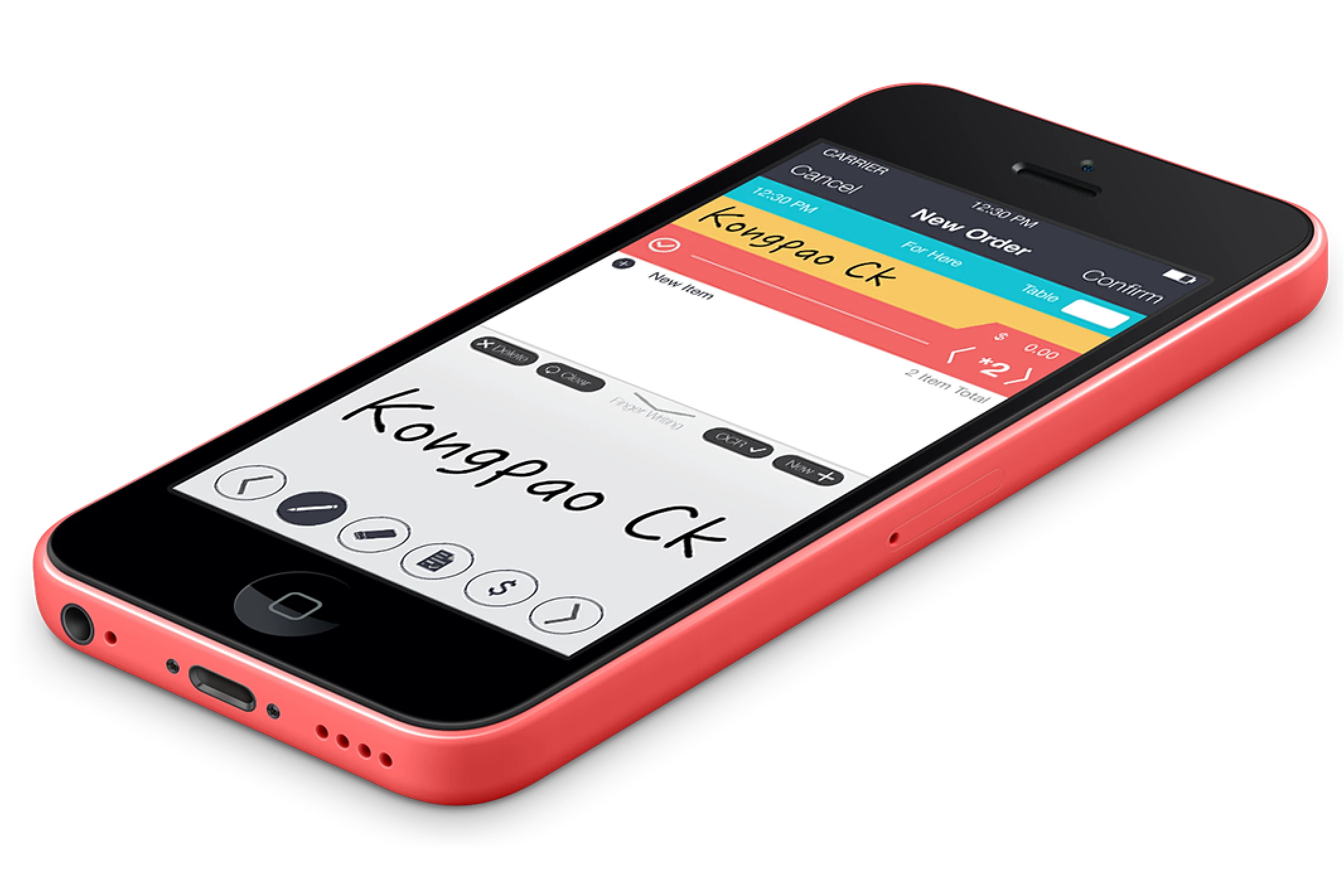
InOrder is a mobile POS concept for small Asian restaurants, built during a research initiative for Polywell. It came out of an unusual research method: I worked part-time as a waiter at a local Chinese restaurant for three months to understand why these restaurants avoid POS systems that look like an obvious efficiency win. The answer wasn't cost, it was language and workflow, which shaped a design built around a finger-writing input method and minimizing staff movement rather than standard POS features.
Background
Understanding the Market & Identifying Gaps
San Francisco has the highest restaurant density per capita of any US city, and Asians make up 33% of its population, so Asian restaurants are a real, competitive market. Polywell's own data showed something odd: small Chinese and Asian restaurants rarely adopt POS systems, unlike their Western counterparts, but since POS was only about 10% of Polywell's business, no one had actually looked into why. I suspected it wasn't a marketing problem but a UX one, and started a research project to find out.
Intriguing Observations
Visiting restaurants directly, and drawing on my prior POS-industry experience, surfaced three patterns:
- Minimal waitstaff even during peak hours, despite good business.
- Surprisingly large menus for such small operations.
- Very low POS adoption despite the obvious efficiency case.
That gap between operational need and actual adoption was the real question worth answering.
Research
A Deep Dive - Immersion in a Local Restaurant
Standard interviews didn't work: staff were too busy to talk, and owners were guarded around direct questions.
So I took a part-time waiter job at a local Chinese restaurant for three months, which gave me a level of access no interview could have, and changed how staff and management talked to me.
**Key Discoveries:**
- **Staffing & costs:** waitstaff salaries are one of the biggest expenses for these restaurants, which pushes many, especially small Chinese ones, to run with a minimal crew.
- **No division of labor:** with fewer people on staff, roles aren't specialized, staff take orders, serve food, clear tables, and help in the kitchen, which becomes a bottleneck at peak times.
- **The owner's actual reasoning:** this is where prior assumptions got confirmed directly.
"They cost too much money. They have maintenance fee, and if you want change menu, more cost. Many people come try sell me machine. I watch how they use, they are just slower. I'm doing business not charity."
Barriers to POS Adoption
Beyond cost, the research surfaced several compounding barriers:
- **Staff turnover** — heavy reliance on part-time staff means constant retraining on any new system.
- **Learning curve** — every POS option has its own, adding hesitation to switching at all.
- **Language barrier** — kitchen staff often aren't proficient in English, which most POS systems assume.
- **Native-language habits** — waiters often relay orders in their native language anyway, which erases the advantage of an English-based system.
- **Physical placement** — POS terminals sit at the cashier station, inconvenient for staff who also work the kitchen.
- **Fear of dependence** — once adopted, the business becomes reliant on the system, which owners are wary of committing to.
Ideation
Mobile Solutions for Streamlining Staff Movement
This was 2014, when smartphones had become universal. My time in the restaurant pointed to one clear inefficiency: waitstaff covering constant "random walking" distance between kitchen, cashier, and tables. That felt directly solvable with mobile technology.
Supporting Challenges
Beyond the movement problem, three secondary issues shaped the design brief:
- **Learning curve** — existing POS systems were hard to pick up, especially for non-English speakers.
- **Workflow compatibility** — standard POS systems didn't match how these restaurants actually operated.
- **Language barriers** — chefs and family members running the business often had limited English.
Ideation Framework
That translated into three design criteria:
- **Minimize movement** — functionality built around reducing staff travel, not adding features.
- **Ease of use** — an interface that needs little to no training.
- **Language inclusivity** — accommodate limited English through visual cues or multilingual support.
Towards a Mobile POS Solution
The resulting concept: a smartphone-based POS that integrates with Polywell's existing product line, keeping staff mobile instead of anchored to a fixed terminal.
It also included the touchscreen's handwriting recognition as a direct answer to the language problem, letting non-English-speaking staff use the system without translation.
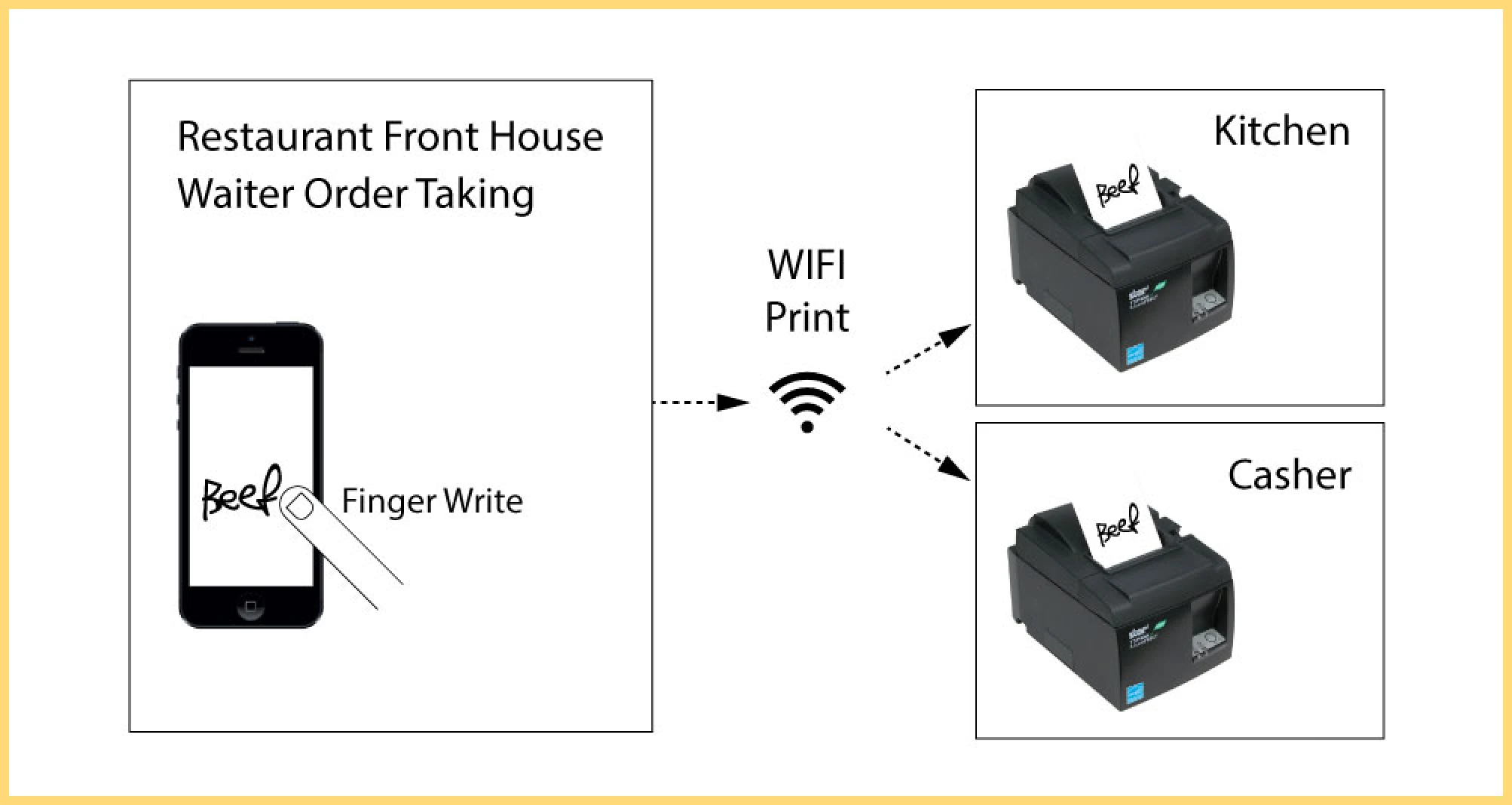
The initial solution concept
Design
From here the ideas became concrete screens, shaped through iteration and stakeholder feedback.
Personas
I built two personas, the Business Manager and the Waiter, based on the research and my own time on the floor, and checked every design decision against both.
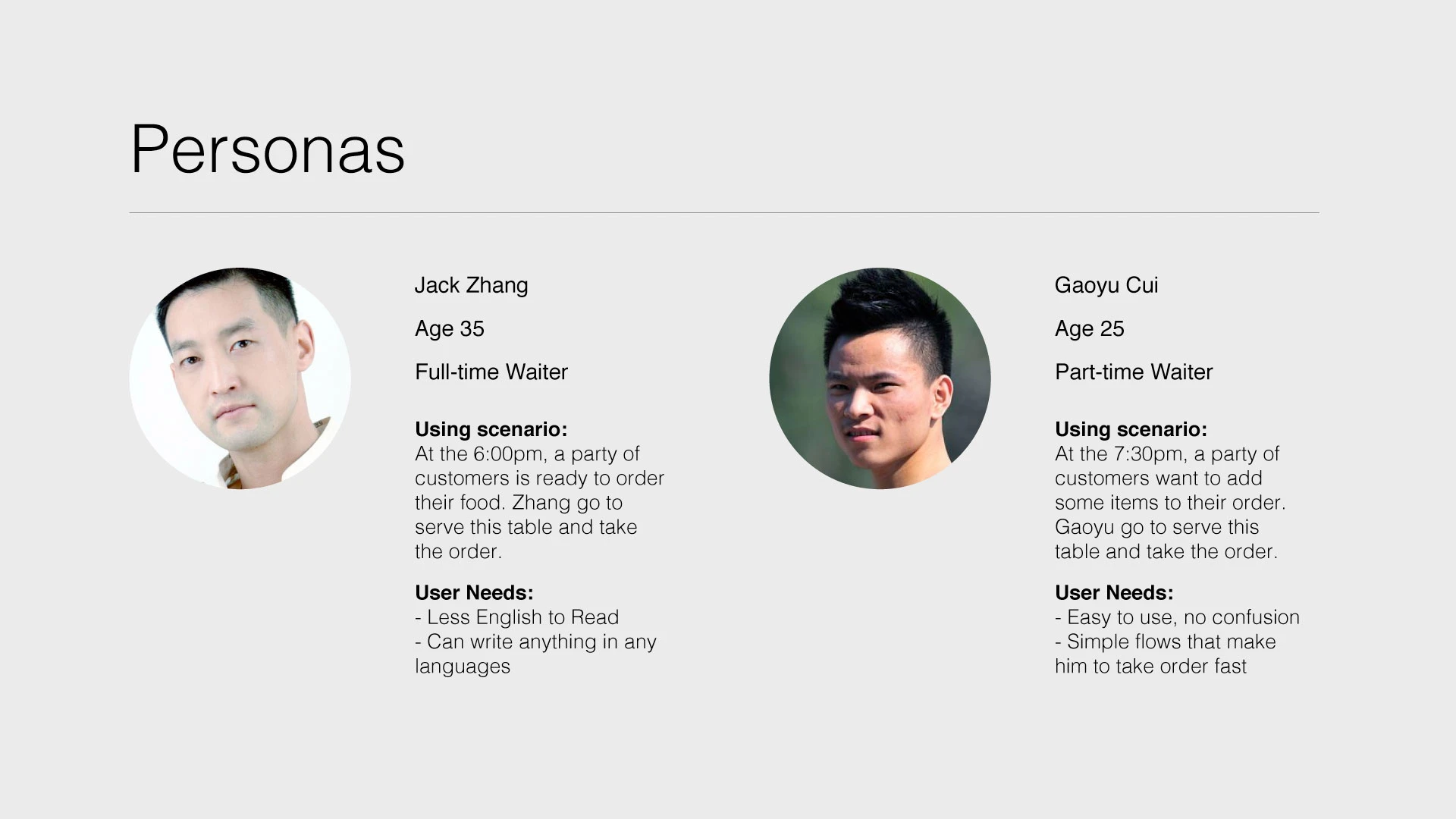
Personas created
Structure
I based the app's information architecture on Polywell's existing product line, so it would integrate cleanly rather than needing its own separate ecosystem.
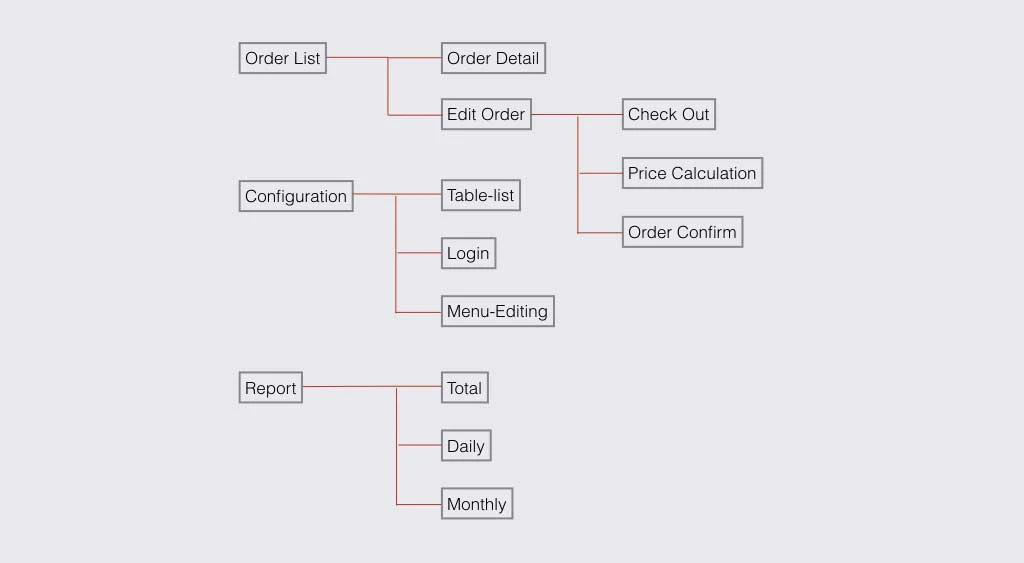
App structure
Wireframes
Wireframes focused specifically on minimizing the "random walking" problem and keeping actions fast, since that was the core inefficiency the whole project was built to fix.
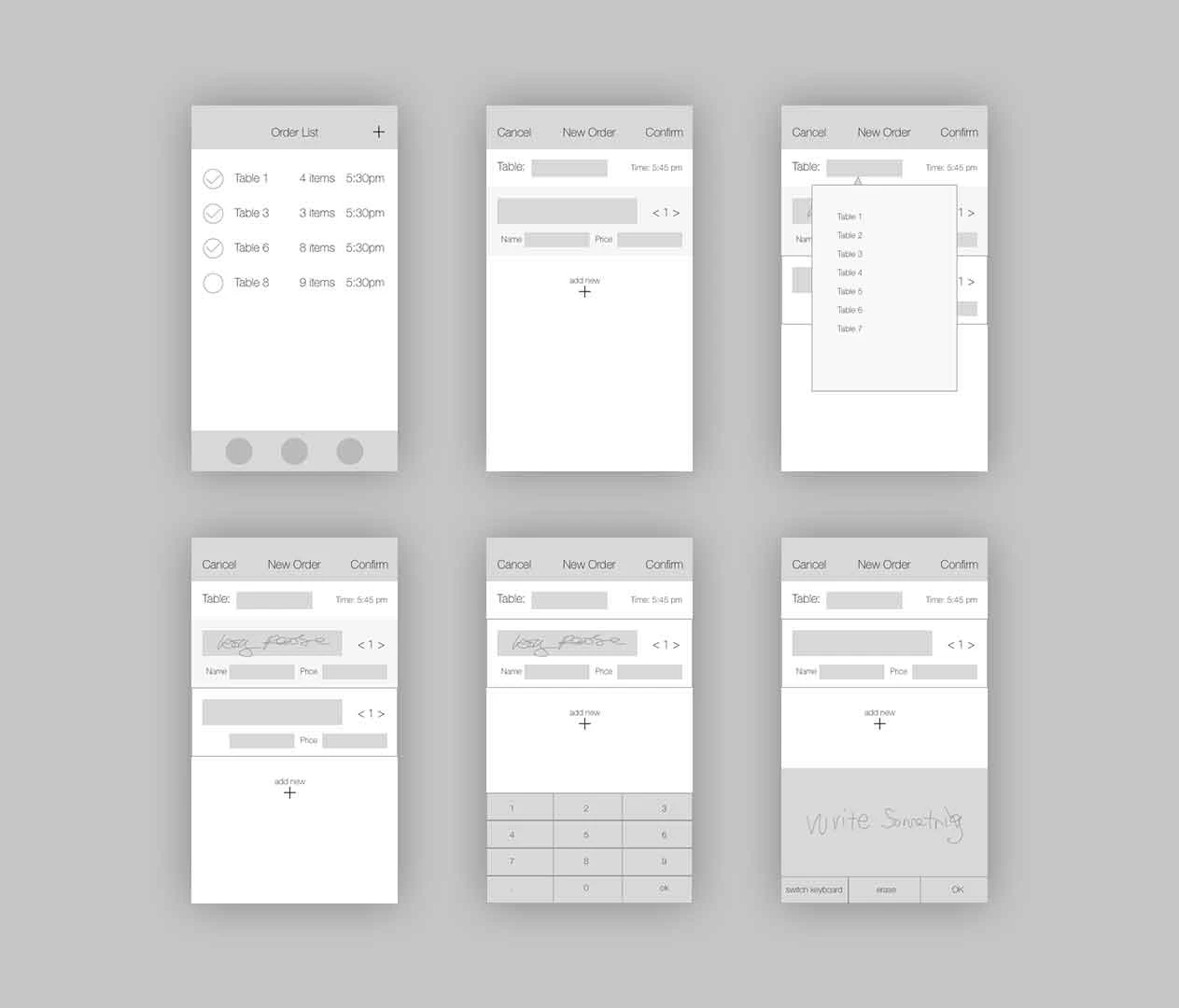
Wireframes
Hi-fi Screens
High-fidelity screens carried that logic through into the final visual language, ready for testing and handoff.
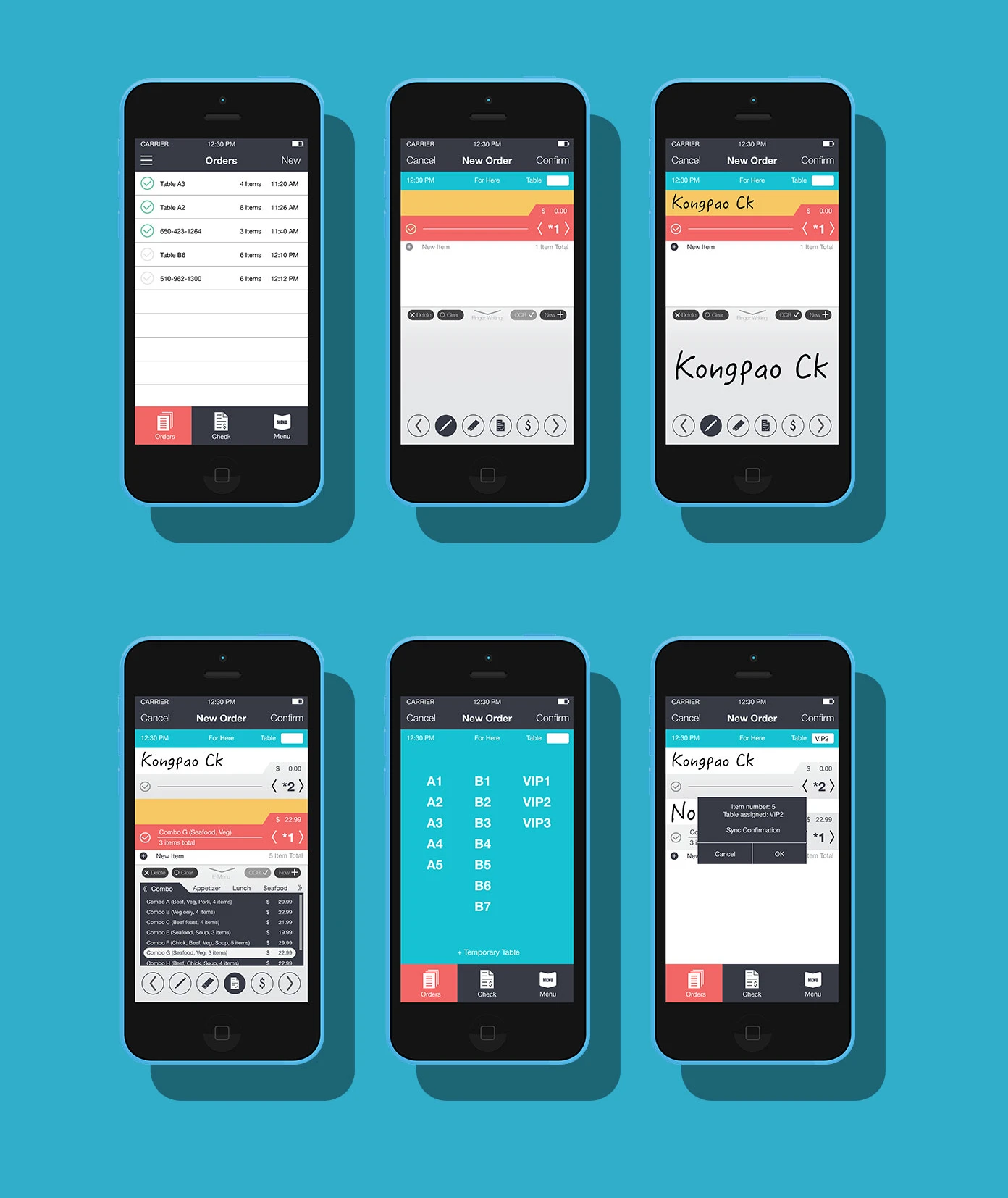
Main UI pages
Concept Video
Insights & Learning
A simplified version of this concept was actually built and shipped by Polywell Computers as a bundled product, not sold standalone or listed in app stores, but real confirmation that the design direction held up past the concept stage.
The bigger lesson was about method: working the floor for three months surfaced things standard interviews never would have, the owner's actual cost calculus, the real reason for role overlap, the specific movement pattern causing fatigue. I've since reused that same field-immersion approach on other research (see the Uber Eats courier study), because it consistently finds the 'why' that surface-level observation misses.